
I have republished my original blog posts from when I sailed on JOIDES Resolution Expedition 390. Click the 390 blog posts tag to review additional postings, #DrGw390 to see my daily social media postings from the ship, and 390 quilt to explore the quilts I generated post-expedition as part of the Stories from the South Atlantic collection.
Any ship on the water, including JOIDES Resolution when it is transiting or kept in one location by the dynamic thrusters during drilling, experiences a heave (vertical up/down movement). This movement can cause challenges when performing the simplest tasks. Some of the basic scientific methods we do in our laboratories cannot be performed the same way on a moving ship! For example, we need to make adjustments when…
LOOKING THROUGH A MICROSCOPE
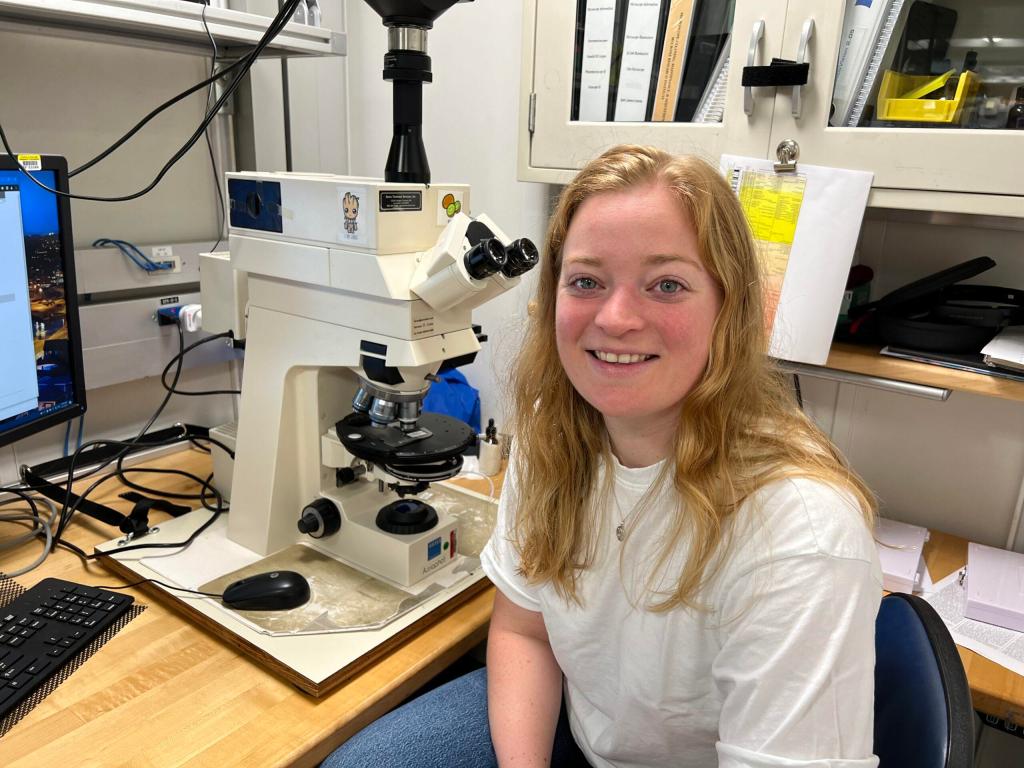
Micropaleonotologist Claire Routledge studies the nannofossils recovered in the sediment sections of our cores. She magnifies her samples 1000x under a microscope, but she is always having to adjust the focus. Without her even turning the focus knob (also called fine focus adjustment at this magnification), the movement of the ship will change the focus on her! One needs to be quick when using a microscope for observation and identification of the microfossils.

WEIGHING SAMPLES
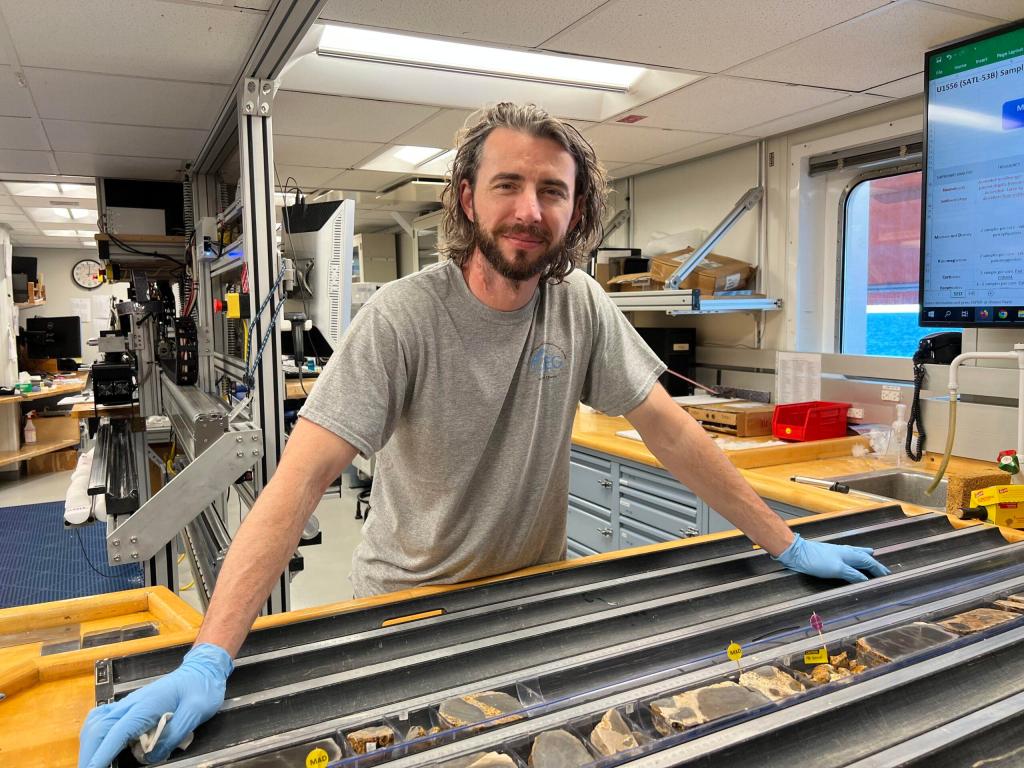
Physical properties specialist Justin Estep only needs one scale to weigh scientific samples back in a laboratory on land. But on JOIDES Resolution, he uses two scales to minimize the influence of the ship’s up and down movement on his measurements. On one scale, he places an item where we know its precise mass – we call this a reference mass. On the other scale, he places the unknown sample that he wants to measure. A computer then records hundreds of repeat measurements of both samples as the boat moves up and down to calculate an accurate value for the weight. When the ship heaves up, the sample will feel heavier and when the ship heaves down, the sample will feel lighter. This is why it is important to use a reference mass.

For example, let’s say Justin’s reference mass is 20 grams. If the computer takes a first measurement of 22 g, then a second measurement of 17 g, then a third measurement of 21 g, etc., the computer can look at all of those measurements to then calculate the correction it needs to apply to the weight of the unknown sample. Looking at many measurements over time helps Justin get a more accurate measurement.
This short video filed by Justin shows a measurement being taken on Expedition 390 and how the weight changes with the heave of the boat. The red line is what is being measured as the mass of sample and the green line is what is being measured as the mass of the reference. The blue line shows the real mass of the sample that is corrected.
These are just two examples of how our data collection is adjusted to accommodate for movement at sea. Thank you to Claire and Justin for taking us through some of the adaptations they make to do science on the ocean!
 Journeys of Dr. G