I really enjoy doing science outreach events and speaking to audiences of any age, with any level of science knowledge. For groups in my region, the Greater Philadelphia Area, I always try to bridge the science content to this location – it helps people with the relevance and connection to the material I am presenting. At times, these connections will generate excitement and a room full of smiles, which gives me hope that the stories I share are then passed on to others.
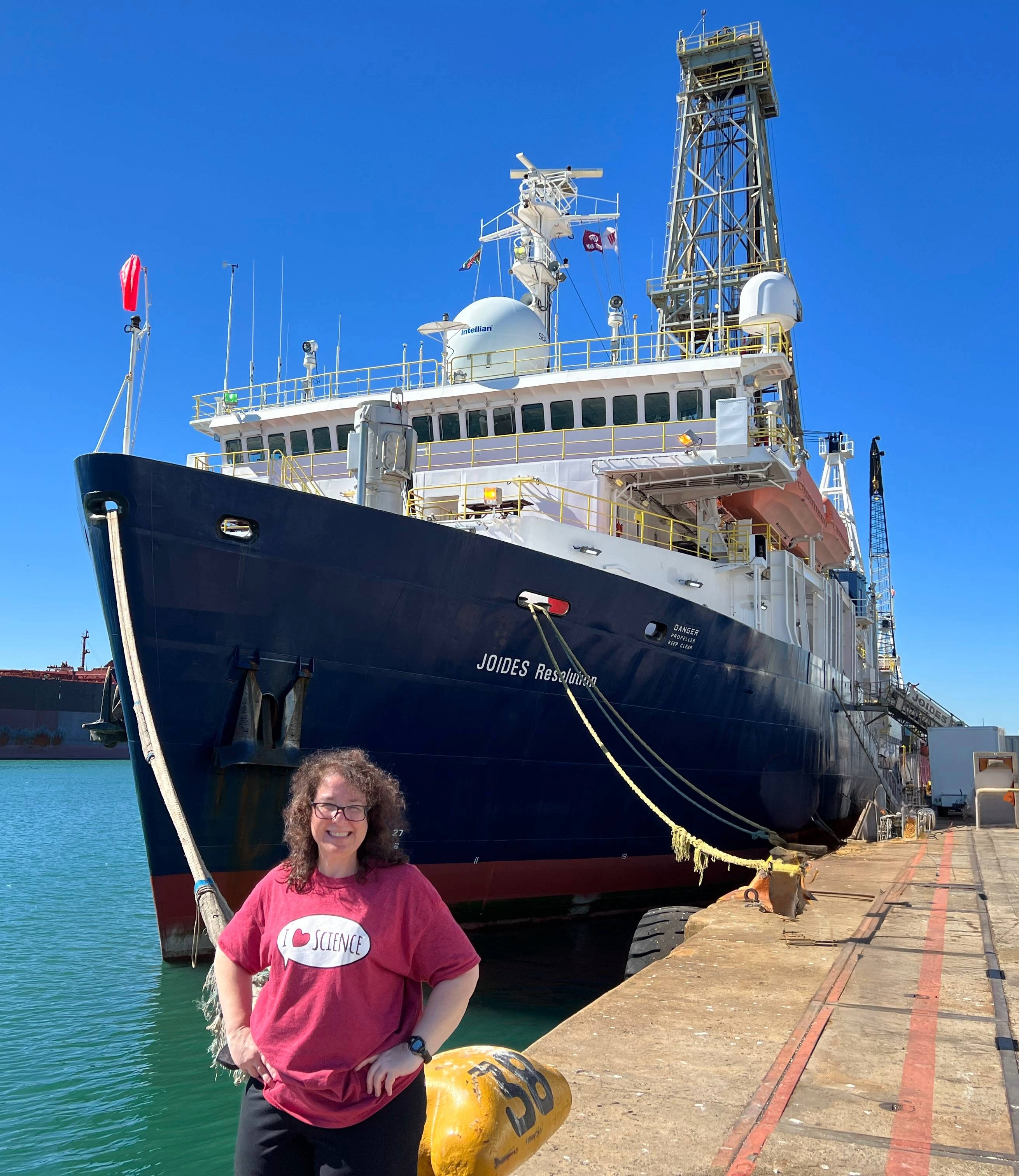
JOIDES Resolution, docked in Cape Town before departure of EXP 390
I had the opportunity to sail on the scientific drilling vessel JOIDES Resolution for the South Atlantic Transect I (EXP 390, April 7 – June 7, 2022). Early in each expedition, scientists are given a tour of the ship, going into areas that are typically off limits for the rest of their time on board. However, my expedition took place while the COPE protocols for COVID-19 were in place for the first 11 days. This meant we were masking and social distancing as much as possible, and did not have the typical start as prior expeditions. This also meant that we didn’t get our full ship tour until much later in the expedition – on May 21, just 10 days before we returned to port. I still had more than enough information to share during my ship-to-shore Zoom sessions, but I didn’t know about the JOIDES Resolution’s connection to Philadelphia until I saw something I never expected to see on a ship at sea.
Spotted in the engine room
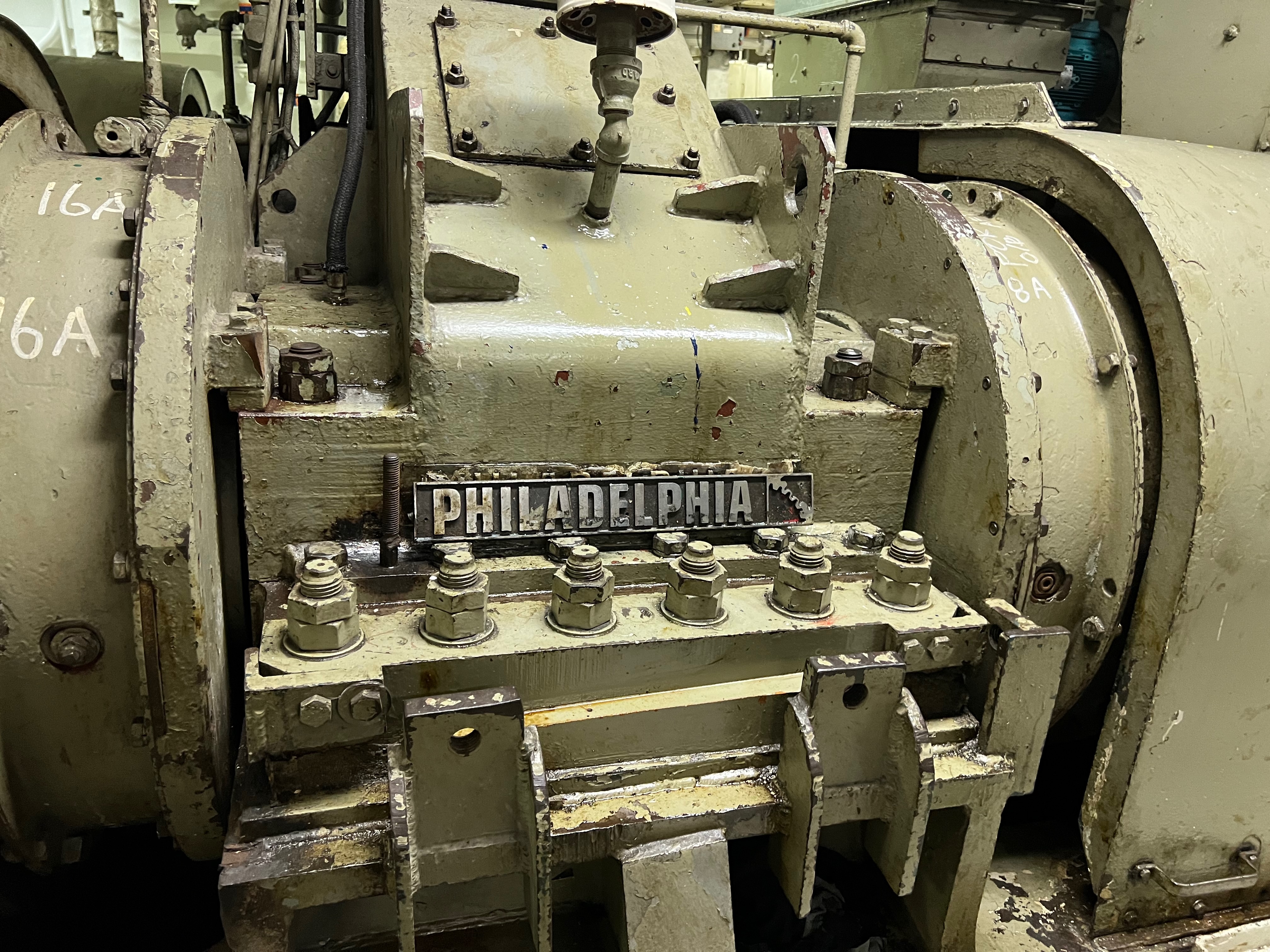
As myself and the other scientists donned our hard hats and safety goggles for our ship tour, we were led down ladders and through hatches we never had seen before. We worked our way through the corridors and rooms filled with equipment and dashboards, taking in everything presented to us by our Operations Superintendent Steve Midgley. One part of the tour took us through the engine room, and as we went around the corner of one of the engines down towards the gear box and propeller shaft, one of the geochemists looked directly at me and pointed out to his side. My gaze followed to where his arm was extended, and I saw the following:
Gear box on the port side with the sign “Philadelphia” sitting on the equipment.
I couldn’t believe my eyes! I snapped as many photos as I could before the tour continued to move along. (And I thank Development Engineer Matt Allen for taking me back down days later to take some additional photographs!). I found another small sign on top of the gear box that was difficult to read, but this information led me to start an interesting investigation.
Sign that states “Philadelphia Marine Gear Drive” on top and “Gear Corporation” visible along the bottom.
The start of the ship
To understand how a gear box labeled with Philadelphia ended up on JOIDES Resolution, let’s take a step back to the beginning of the ship itself.
Halifax Shipyard Ltd. in Nova Scotia, Canada, founded in 1889, was the site of construction for SEDCO/BP471 (later officially renamed JOIDES Resolution). This ship was built by Hawker Industries and was the 68th hull constructed by this shipyard. Shell Oil and SEDCO (Southeastern Drilling Company) had put into service the world’s first exploratory drilling vessel with dynamic positioning for the petroleum industry (SEDCO 445, in 1971), and SEDCO/BP 471 was the start of a new generation of dynamically positioned oil drill ships in 1978 (Martin et al., 1978). This ship’s name reflected her ownership and class – owned 50% by British Petroleum Corporation (BP) and 50% by Sedco Forex, an arm of Multinational Schlumberger Ltd. She was the first of a class of Sedco-designed drillships that were 470 feet (143.2 m) in length (Foss, 1985).
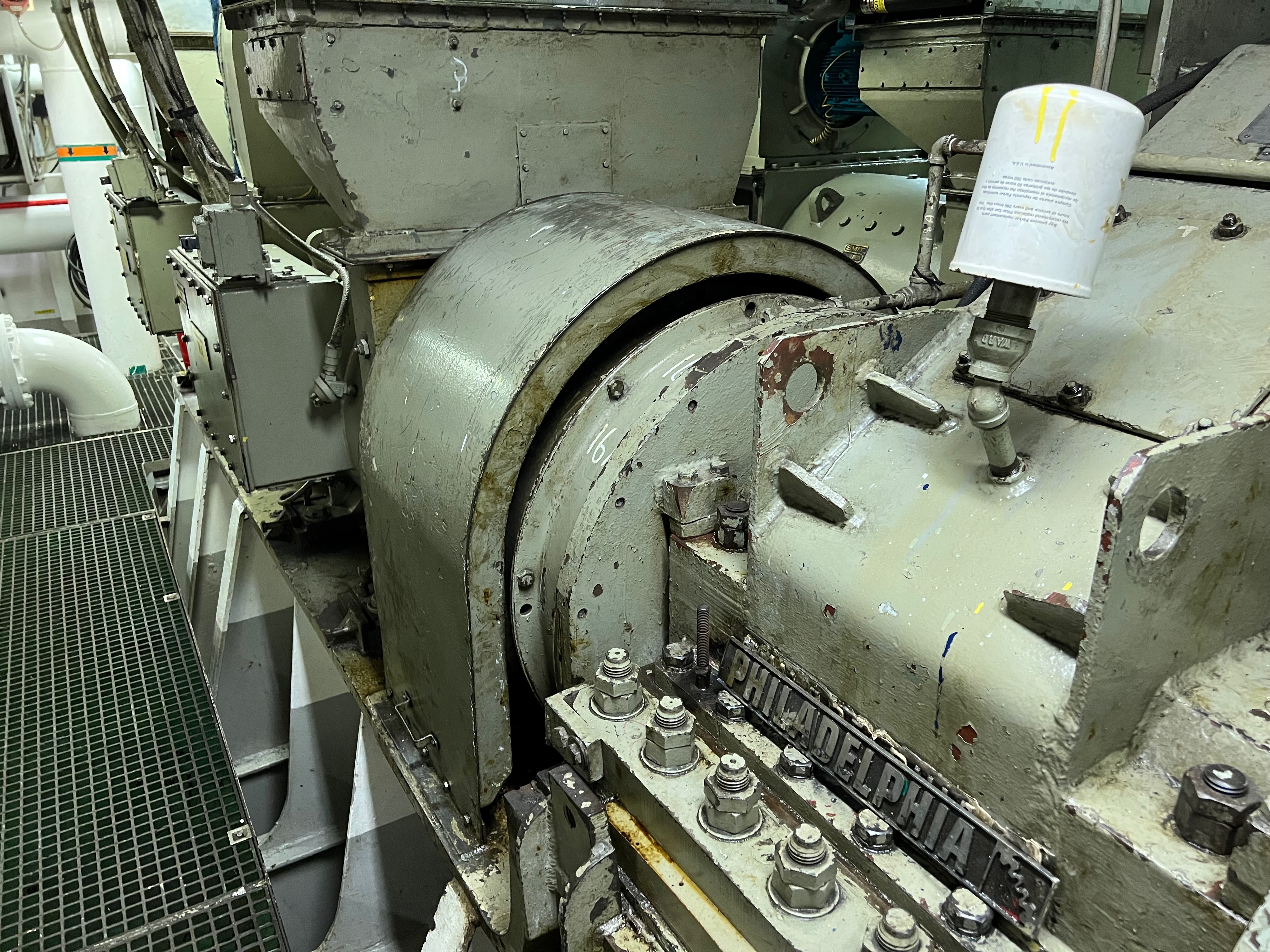
The story of the company that manufactured JOIDES Resolution’s gear box starts in 1892 with Philadelphia Gear Works. This business started here to serve the steel and anthracite coal industries of Pennsylvania, but by 1917 (during World War I) expanded to include production of gears, sprockets, chains, and automotive transmissions for ships, planes, munitions, tanks, and machinery. As their product line increased, so did the need for space for production. In 1960, Philadelphia Gear expanded to King of Prussia, PA, and was sending products to NASA, the U.S. Navy, Alaska Pipeline, offshore drill rigs, and more. Clearly, some of the gear boxes ended up in the Halifax Shipyard as well!
Another view of the gear box in JOIDES Resolution, manufactured by Philadelphia Gear.
But wait! There’s more…
In Coatesville, Pennsylvania, one can visit The National Iron & Steel Heritage Museum, a museum “whose mission is to promote an understanding of the iron and steel history of Coatesville, Chester County, Southeastern Pennsylvania and the region to audiences of all ages and interests by collecting, preserving, exhibiting and interpreting iron and steel’s history and its relationship to the region and nation beyond” (see the video overview). In one of the online exhibits, there is a page titled SEDCO/BP 471 with a photo of the ship before it was renamed JOIDES Resolution, and the following caption:
Lukens supplied 294 tons of ABS Section 43 Grade DS structural quality plate for the lower hull plates which were exposed to ice and low temperatures. — The National Iron & Steel Heritage Museum, page for SEDCO/BP 471
Lukens Steel Company has its own fascinating history, going back to the early 1800’s. Wikipedia and the Pennsylvania Center for the Book describe how in 1818, a small iron rolling mill in Coatesville, Chester County began to produce rolled iron plates “that rivaled the best in the world.” Dr. Charles Lukens and the Brandywine Iron Works and Nail Factory, later to become Lukens Steel Company, produced rolled iron plate in sufficient quantity – the first iron of its strength and quality in the country. When Charles died unexpectedly in 1825, his wife Rebecca Lukens took over and is recognized as America’s first woman industrialist, for much of the success and prolific output of Lukens Steel is credited to her work.
And, it’s very probable that Lukens Steel was also used for the construction of Glomar Explorer, as the two companies were so close and it is documented that Lukens provided steel to Sun Shipbuilding & Drydock Company, where Glomar Explorer was built (yet another connection!). [The photo on the left was taken by me during a visit to The National Iron & Steel Heritage Museum in August 2025, where the display on ships shows photos of Glomar Explorer and SEDCO/BP 471 presented together]
Summary
So it turns out that the Greater Philadelphia Region is represented not just inside JOIDES Resolution, but outside as well!
I look forward to continuing to share with others how the Philadelphia area played a role in contributing materials to this significant scientific research vessel.
Gear box, thanks to Philadelphia Gear BoxLower hull, thanks to Lukens Steel Company
[…] submersible HOV Alvin had its sphere constructed from Lukens steel. And I’ve mentioned in a previous blog post that some of the hull material for JOIDES Resolution (then SEDCO/BP 471) was acquired from Lukens […]
[…] in prior blog posts the connection between Lukens steel and the construction of the hull of JOIDES Resolution, Glomar Explorer, and GUPPY. This blog post will highlight a large object viewable outdoors in the […]





 Journeys of Dr. G
[…] submersible HOV Alvin had its sphere constructed from Lukens steel. And I’ve mentioned in a previous blog post that some of the hull material for JOIDES Resolution (then SEDCO/BP 471) was acquired from Lukens […]
LikeLike
[…] in prior blog posts the connection between Lukens steel and the construction of the hull of JOIDES Resolution, Glomar Explorer, and GUPPY. This blog post will highlight a large object viewable outdoors in the […]
LikeLike