
As I author this blog post, there is incredible uncertainty and uneasiness as to the future of a fundamental federal agency, the National Oceanic and Atmospheric Administration (NOAA). The history of NOAA is a fascinating read, with the agency going back over 200 years and starting as:
- February 10, 1807: President Thomas Jefferson signs an Act to provide for surveying the coasts of the United States. Survey of the Coast was the first scientific agency of the United States.
- February 9, 1870: President Ulysses S. Grant signed a U.S. Congressional resolution to establish the Weather Bureau for taking meteorological observations.
- February 9, 1871: President Grant created the Office of Commissioner of Fish and Fisheries as the first federal agency focused on natural resource conservation.
Fast-forward to July 9, 1970, when President Richard Nixon relayed reorganization plans to Congress to establish the National Oceanic and Atmospheric Administration and Environmental Protection Agency. You can review online his orignial proposed components of NOAA. President Nixon signed NOAA into existence on October 3, 1970 (the EPA was later created on December 2, 1970).
Why mention the history of NOAA? In addition to learning that the three original units were established before the word “oceanography” even existed (it came about from the voyage of H.M.S. Challenger in 1873), it’s important to take a moment to reflect upon just how long NOAA has been in place to provide science, service, and stewardship of our hydrosphere and atmosphere. NOAA’s mission (as of March 2025) is:
1. To understand and predict changes in climate, weather, ocean and coasts.
2. To share that knowledge and information with others.
3. To conserve and manage coastal and marine ecosystems and resources.
There are numerous resources to learn more about NOAA, such as the NOAA articles Celebrating NOAA at 50 and NOAA protects every American…powers our economy. I blogged numerous times on my AGU blog GeoEd Trek about NOAA, blog posts which include:
- What NOAA means to me, and how to “make it matter” to others (March 2017)
- A New Year’s resolution: help the public learn about NOAA (December 2017)
- A conversation about science communication with NOAA’s RDML Tim Gallaudet, Ph.D. (March 2018)
But now, it’s time to re-engage and do more to promote and advance the mission and impact of NOAA. You don’t need to be living at the ocean to benefit from NOAA. After all, this is the “agency that enriches life through science. Our reach goes from the surface of the sun to the depths of the ocean floor as we work to keep the public informed of the changing environment around them” (from About our agency).
In 2022, I made a quilt that calls attention to all of the key focus areas of NOAA’s work. This quilt then highlights the key focus areas of NOAA’s work: research, weather, climate, ocean & coasts, fisheries, charting, satellites, marine & aviation, sanctuaries, and education.
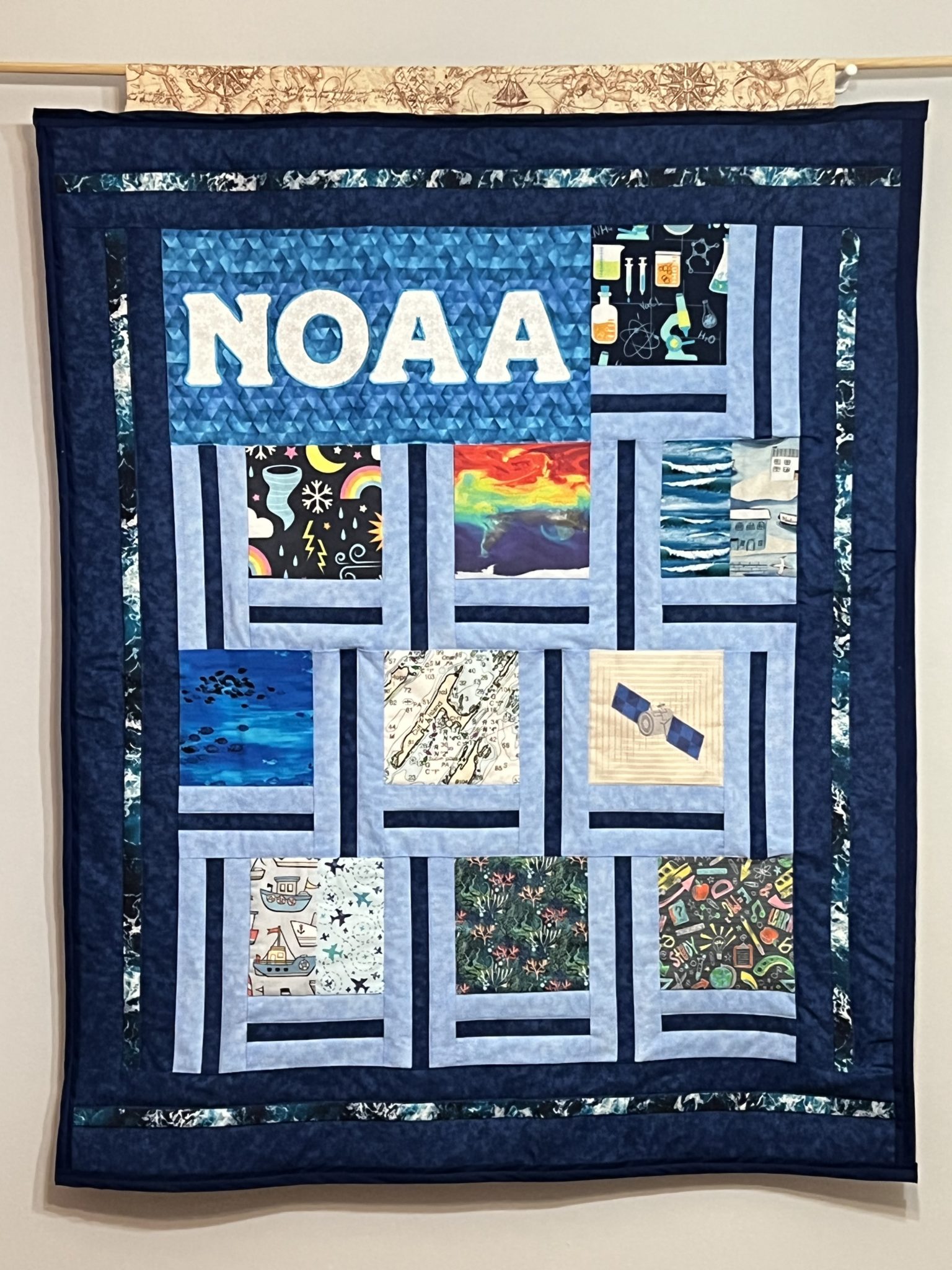
This video shows a close-up of the fabrics in the quilt.
Quilt was completed February 17, 2022, and measures 39 inches across by 48.5 inches tall.
Keep an eye out for additional quilts that I will be creating in the upcoming months to further highlight the work of each of these areas. NOAA is too important to not take the time for raising awareness and sharing stories with others.


[…] addition to thanking NOAA for the incredible impact it has had on my career, I want to help others Know about NOAA and how it impacts each and every one of our lives on a daily […]
LikeLike