
I am one of the six speakers that are a part of the Ocean Discovery Lecture Series for 2025-2026. My scientific ocean drilling colleagues and I are traveling to institutions across the United States to speak about the JOIDES Resolution expeditions on which we sailed, sharing the sites we visited, the science we have learned, and the connections to society.
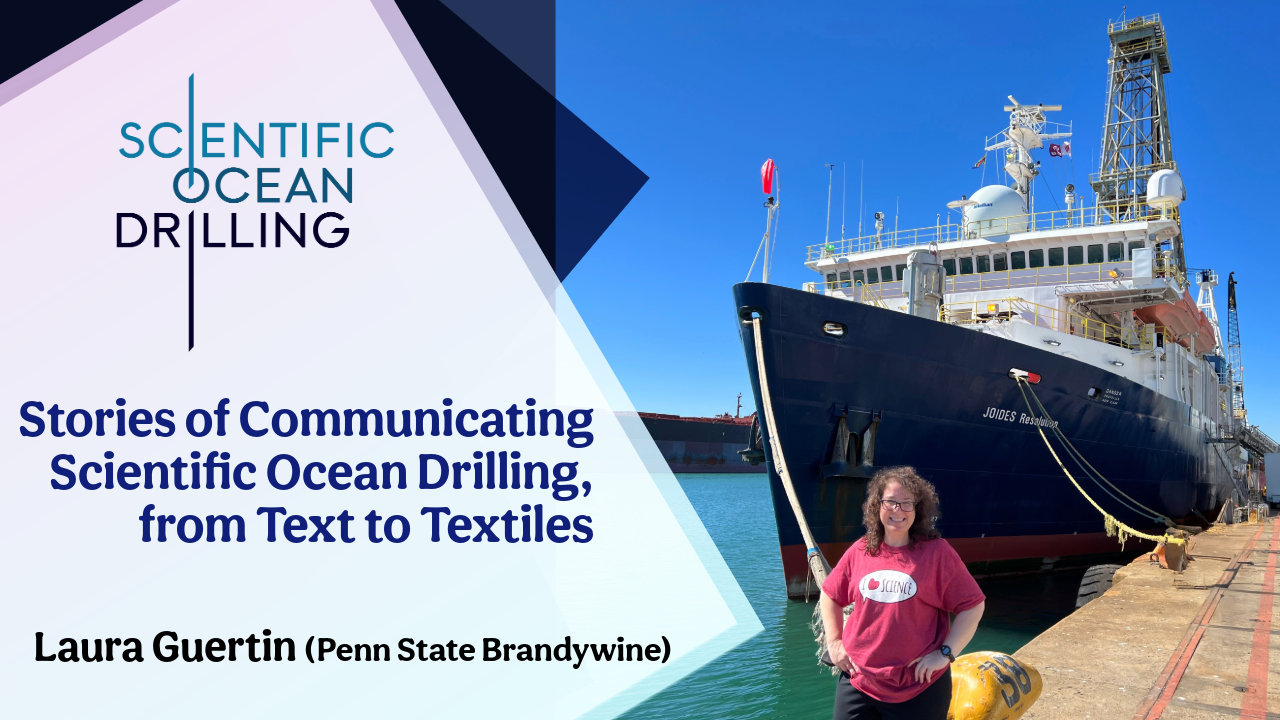
My title and description:
STORIES OF COMMUNICATING SCIENTIFIC OCEAN DRILLING, FROM TEXT TO TEXTILES
Starting with the very first scientific oceanographic research expedition, scientists in this field have been sharing their discoveries with wide-ranging audiences. Tales of adventures at sea are disseminated in the popular press (social media, magazines, books, etc.), while the completed analyses of deep-sea samples are published in scholarly reports and peer-reviewed journals. This presentation will highlight specific examples of how scientific ocean drilling expeditions have been shared from CUSS 1 (Project Mohole), Glomar Challenger, and JOIDES Resolution. A spotlight will be placed on DSDP Leg 3 from 1969, the expedition that provided the evidence for plate tectonics, and IODP Expedition 390, which visited the region just over 50 years later and on which I sailed in 2022 as an Onboard Outreach Officer.
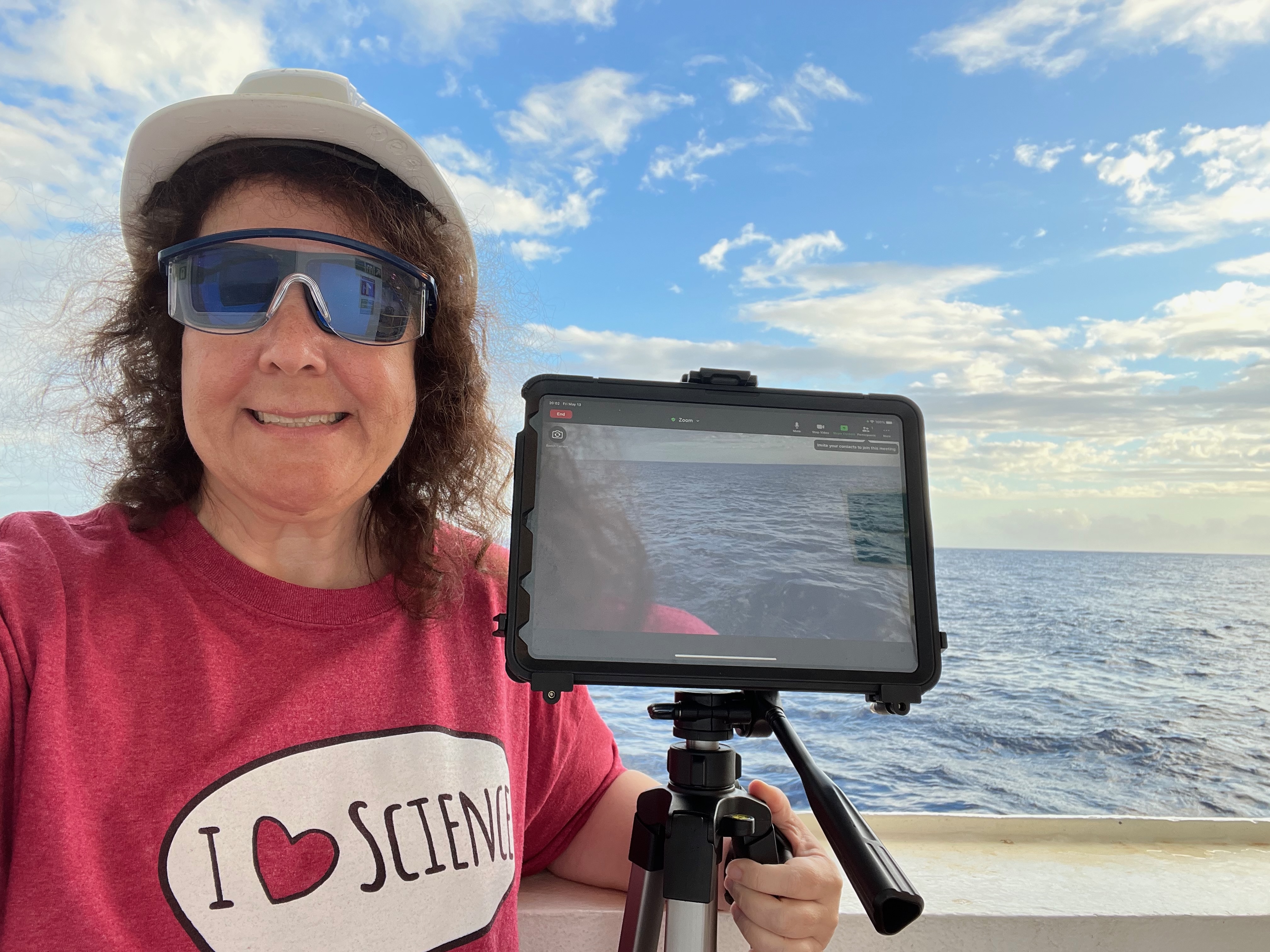
In addition to sharing the process of science at sea through social media, daily geospatial updates, blog posts, and Zoom sessions, I have continued disseminating stories post-expedition through audio narratives and the generation of a quilt collection that includes data visualizations and gamified tapestries. This presentation will include audio clips from scientists that sailed on early and more recent scientific ocean drilling expeditions, exemplifying their experiences with ship-to-shore communications and access to global news. Select quilts from the Stories of the South Atlantic (IODP Exp. 390) collection will also be showcased at the talk.
The remainder of this page is a collection of the resources I used to build my talk, whether it be articles, websites, library image databases, and more. I hope those in attendance at my talk will be inspired to further explore one or more of the topics I discuss.
Resources

Open Educational Resource (OER) – Scientific Ocean Drilling: Exploration and Discovery through Time, by L. Guertin, E. Doyle, T. Peixoto
Books, ship logs, and articles
These are books and articles I mentioned during my presentation and/or pulled information from, listed alphabetically by author.
- Bascom, W. (1980). The First Deep Ocean Drilling. In: M. Sears & D. Merriman (Eds.), Oceanography: The Past. Proceedings of the Third International Congress on the History of Oceanographpy. Springer-Verlag. p. 316-324.
- Campbell, C.C. (1881). Log-letters from “The Challenger”. London: Macmillan. (full text online)
- Challenger Expedition (1872-1876). Report on the scientific results of the voyage of H.M.S. Challenger during the years 1873-76 under the command of Captain George S. Nares … and the late Captain Frank Tourle Thomson, R.N. (full text of volumes available as PDF files)
- Deep Sea Drilling Project – University of California, San Diego – Scripps Institution of Oceanography. (n.d.). Scientific Objectives and Highlights. (full text online)
- Doyle, A.C. (1892, July). The Glamour of the Arctic. The Idler. (full text of magazine article)
- Doyle, A.C. (1897, January). Life on a Greenland Whaler. The Strand Magazine. (full text of magazine article)
- Doyle, A. C., Lellenberg, J. (Ed.), & Stashower, D. (Ed.) (2012). Dangerous work: Diary of an Arctic adventure. University of Chicago Press. 368 pages. (publisher site, Google Books preview, full text of Doyle’s log)
- Evans, N. (2021). The Book of Sea Shanties: Wellerman and Other Songs from the Seven Seas. Welbeck. 177 pages.
- Fenton, C. (2019). A Cat Called Trim. Allen & Unwin. 32 pages. (Google Books preview)
- Hayes, D.E., Frakes, L.A., & The Leg 28 Science Party. (1975). Initial Reports of the Deep Sea Drilling Project – Volume 28. U.S. Government Printing Office. https://doi.org/10.5281/zenodo.15133233 (full text online)
- Hess, H.H. (1959, December). The AMSOC hole to the Earth’s mantle. Eos, Transactions American Geophysical Union, Volume 40, Issue 4, p. 340-345. https://doi.org/10.1029/TR040i004p00340
- Hsü, K.J. (1992). Challenger at Sea: A Ship That Revolutionized Earth Science. Princeton University Press, 464 pages. (publisher site, Google Books preview)
- Laurence, W.L. (1959, September 6). SCIENCE IN REVIEW: World Oceanographic Congress at U.N. Seeks Clues to Origin of Life. The New York Times, Section E, p. 9.
- Macdougall, D. (2019). Endless Novelties of Extraordinary Interest: The Voyage of H.M.S. Challenger and the Birth of Modern Oceanography. Yale University Press. 288 pages. (Google Books preview)
- Moseley, H. (1879). Notes by a naturalist on the “Challenger”, being an account of various observations made during the voyage of H.M.S. “Challenger” around the world, in the years 1872-1876, under the commands of Capt. Sir G. S. Nares and Capt. F. T. Thomson. London, Macmillan and Co. (full text online)
- Musemeche, C. (2022). Lethal Tides, Mary Sears and the Marine Scientists Who Helped Win World War II. Harper Collins. 320 pages. (Google Books preview, book review)
- National Research Council. (1965). Report on the U.S. Program for the International Geophysical Year: July 1, 1957 – December 31, 1958. Washington, DC: The National Academies Press. https://doi.org/10.17226/26118. (full text online)
- Pinkerton, B. (2021, March 17). How an ill-fated undersea adventure in the 1960s changed the way scientists see the Earth. Vox. (podcast and article)
- Powell, J.L. (2024). Mysteries of the Deep: How Seafloor Drilling Expeditions Revolutionized Our Understanding of Earth History. The MIT Press. 274 pages. (publisher site, Google Books preview)
- Rehbock, P.F. (1993). At Sea with the Scientifics: The Challenger Letters of Joseph Matkin. University of Hawaii Press. 424 pages.
- Robinson, R., S.Tikoo, P. Fulton. (2024). Sea changes for scientific ocean drilling. Physics Today, 77(2): 28-34. (full text online)
- Sears, M. (Ed.). (1961). Oceanography; invited lectures presented at the International Oceanographic Congress held in New York, 31 August-12 September 1959. Publication (American Association for the Advancement of Science), no. 67. 676 pages. (full text online)
- Shor, E.N. (1985). A chronology from Mohole to JOIDES. In: E.T. Drake & W.M. Jordan (Eds.), Geological Society of America Centennial Special Volume 1. Geological Society of America. p. 391-399.
- Sobel, D. (1995). Longitude – The True Story of a Lone Genius Who Solved the Greatest Scientific Problem of His Time. Penguin Books. 184 pages. (Google Books preview)
- Spry, W.J.J. (1877). The cruise of Her Majesty’s ship “Challenger”. Voyages over many seas, scenes in many lands. London. (full text online)
- State Library of NSW (n.d.). Matthew Flinders: Australia on the map. (full text online)
- Steinbeck, J. (1951). The Log from the Sea of Cortez. The Viking Press. 288 pages. (*published Penguin Classics w/Introduction by Richard Astro, Google Books preview)
- Steinbeck, J. (1961, April 14). High drama of bold thrust through ocean floor. LIFE Magazine, p. 110-122. (full text online)
- Truswell, E. (2019). A Memory of Ice: The Antarctic Voyage of the Glomar Challenger. ANU Press. 220 pages. (PDFs of chapters, read online (HTML), Google Books full view, book review)
- Valentine, S. (2025, July 15). Whaling Records Can Help Improve Estimates of Sea Ice Extent. EOS, 106, https://doi.org/10.1029/2025EO250251 (full text online)
- Wales, W. (1772-1775). Log book of HMS ‘Resolution’, compiled by William Wales during his passage to the South Seas under the command of Captain James Cook, details the testing of the Larcum Kendall (K1) chronometer. (full text of Wales’ log)
- Wolfle, D. (1980). The 1959 Oceanographic Congress: An Informal History. In: Sears, M., Merriman, D. (Eds.), Oceanography: The Past. Springer, New York, NY. https://doi.org/10.1007/978-1-4613-8090-0_5
- Wood, G.D. (2025). The Wake of HMS Challenger: How a Legendary Victorian Voyage Tells the Story of Our Oceans’ Decline. Princeton University Press. 311 pages. (limited preview)

Audio, photos, and video
These are videos I showed and/or mentioned during the lecture.
- StoryCorps Archive for Tales from the Deep: Stories of Scientific Ocean Drilling
- Conversation with Keir Becker – “One of the take-home messages is just how important it was to participate on Glomar Challenger and JR in terms of developing my own career”
- Conversation with Kristin Dickerson – “On the ship, everyone was invited on to be a scientist. Nobody was invited as a student. I was treated like a colleague.”
- Conversation with Tracy Quan – “I made it about two weeks into the cruise, and my watch battery died. We went looking all over the ship, under the floor and in cabinets”
- Google Earth files from Expedition 390 (main page)
- NOVA PBS documentary – Arctic Ghost Ship (Sir John Franklin’s lost expedition (Note this program was originally broadcast in 2015. The HMS Terror was discovered by the Arctic Research Foundation in 2016.))
- University of Wisconsin Milwaukee – General chart of Terra Australis or Australia, showing the parts explored between 1798 and 1803 / by M. Flinders, Commr. of H.M.S. Investigator (map also located at State Library NSW)
- National Academy of Sciences (NAS) International Geophysical Year main archive and IGY page that lists posters by Herbert Danska representing different areas of geophysics studied during the 1957-1958 IGY: Earth, Oceans, Poles, Space, Sun & Earth, Weather
- PBS News Hour stories on the discovery of the Endurance (PBS Story, YouTube video)
- Shutterstock – Mohole project editorial images (~1,000 images to scroll through), and six Project Mohole images from Getty Images
- State Library of New South Whales – British Imperial Trans-Antarctic Expedition, 1914-1917 / Paget plates by Frank Hurley (view all 32 in the online archive)
- Shutterstock – Mohole project editorial images
- Wikimedia Commons – File:Kart over Fridtjof Nansen’s Polarexpedition 1893-1896 – no-nb krt 00913.jpg – National Library of Norway, Public domain
- Wikimedia Commons – File:Fram Bergen 1893.jpg – National Library of Norway, Public domain
- YouTube – “The Wreck of the Edmund Fitzgerald” – Gordon Lightfoot (HD w/ Lyrics)
- YouTube – “Wellerman” – The Wellermen (Official TikTok Video)
- YouTube – “Operation Deep Freeze I” – Periscope Film II; also “Operation Deep Freeze I” – Naval History and Heritage
- YouTube – “Ike opens International Geophysical Year 1957“
- YouTube – “Drone video of the R/V Joides Resolution“
- YouTube – “JR In a Minute Core Drilling“
- YouTube – “The Life of a Core“
- YouTube – “Heider and Simmel (1944) animation“
- YouTube – “Call Me Maybe” – Carly Rae Jepsen
- YouTube – “Leaving Of Liverpool” – The Wellermen (Official Lyric Video)

Websites and blog posts
This list has, in the order of my presentation, links to websites with additional information on various topics.
- Library of Congess blogs – A Deep Dive Into Sea Shanties
- Glomar Explorer – historical marker, and how it almost became a scientific ocean drilling vessel
- The Larcum Kendall K1 chronometer – Royal Museums Greenwich and Quill & Pad post
- Another story highlighting the chronometer describes how Endurance captain Frank Worsley, Shackleton’s gifted navigator, knew how to stay the course
- Captain Matthew Flinders – The Flinders Papers, Matthew Flinders: Australia on the Map, Matthew Flinders’ biographical tribute to his cat Trim [Isle of France, December 1809], and Trim (cat) [Wikipedia]
- PBS News Weekend – How 200-year-old whaling logs are helping scientists track climate change, and citizen science projects to transcribe ship log books with weather records include Weather Rescue at Sea and Old Weather
- Mystic Seaport Museum – Charles W. Morgan, the last wooden whaling ship
- Royal Museums Greenwich – The Challenger Expedition research guide
- Journeys of Dr. G blog – The ships that sailed before us
- GeoEd Trek blog – The science communications from H.M.S. Challenger were “Good Words” and more
- International Geophysical Year – articles/letters stored with the National Archives
- Journeys of Dr. G blog – Communications from the sea – before personal Wi-Fi
- Journeys of Dr. G blog – Glomar Explorer – the ship that almost was a scientific ocean drilling vessel
- GeoEd Trek blog – The missions of H.M.S. Challenger and JOIDES Resolution – a comparison of ocean exploration then and now
- Website – Stories from the South Atlantic Ocean, Highlights of an IODP Expedition via Quilts
Science communication tools and training
- COMPASS Message Box (website and workbook)
- And-But-Therefore (ABT) Narrative (website, article, video and book The Narrative Gym in general and for science)
- AGU SciComm Toolkits (includes information for connecting with policymakers) (website) and the overall AGU Science Communication website
- AAAS Engaging Policymakers (toolkit and more)
- TED Talk from Dr. Katharine Hayhoe, The most important thing you can do to fight climate change: talk about it
- Article – An agenda for science communication research and practice (PNAS, 2025)
- Organizations
- Association of Science Communicators (ASC)
- Oral History Association (OHA), and their Oral History Best Practices page
 Journeys of Dr. G

