
When I taught coastal oceanography in Fall Semester 2023, I had the students in each section of the course author stories relating to coastal climate solutions. These solutions are ones researched and modeled by Project Drawdown. To wrap up their project, students drew an image relating to their stories on fabric squares, which resulted in two collaborative student quilts on Coastal Climate Solutions.
Fast-forward to Fall Semester 2024, and I found myself again teaching two sections of coastal oceanography. This time, the students wrote stories along two different themes. Once section of the course selected topics written about and published by Hakai Magazine. With the news of Hakai Magazine losing their funding and shutting down, we created a Thank you, Hakai Magazine quilt to honor and celebrate the excellent, independent journalism by this publication.
The other section (the focus of this blog post) each selected a coastal topic that corresponded with a different letter of the alphabet, for students to author coastal stories and yes, a collaborative alphabet quilt.
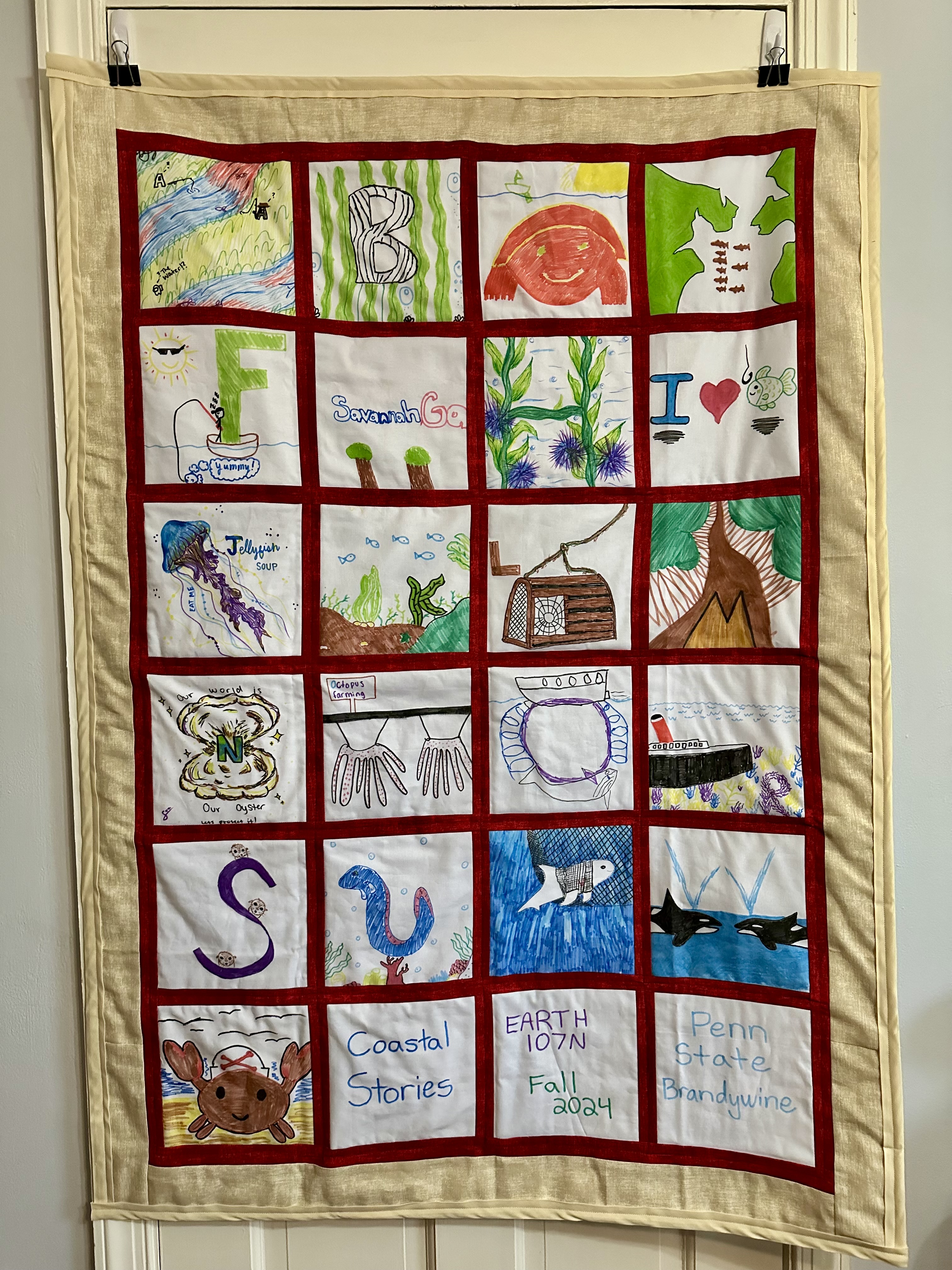
Unfortunately, with some students dropping the course during the semester, we lost some letters of the alphabet. But I still went through and finished stitching the quilt in honor of the work completed by the students. The squares correspond to the following letters and articles.
- Top row, left to right
- Toxic Algal Bloom Affecting California Sea Lions and Dolphins — A square by Evangeline Gove
- Climate Change Threatens the Survival and Recovery of Black Abalone — B square by Matthew Barrowclough
- Snow Crab Collapse Due to Ecological Shift in the Bering Sea — C square by Nicholas Favazza
- New Evidence of Seasonal and Temperature-Driven Movement of Alaska Pollock across the U.S.-Russia Maritime Boundary (EEZ story) — E square by Reece Kiesling
- Second row, left to right
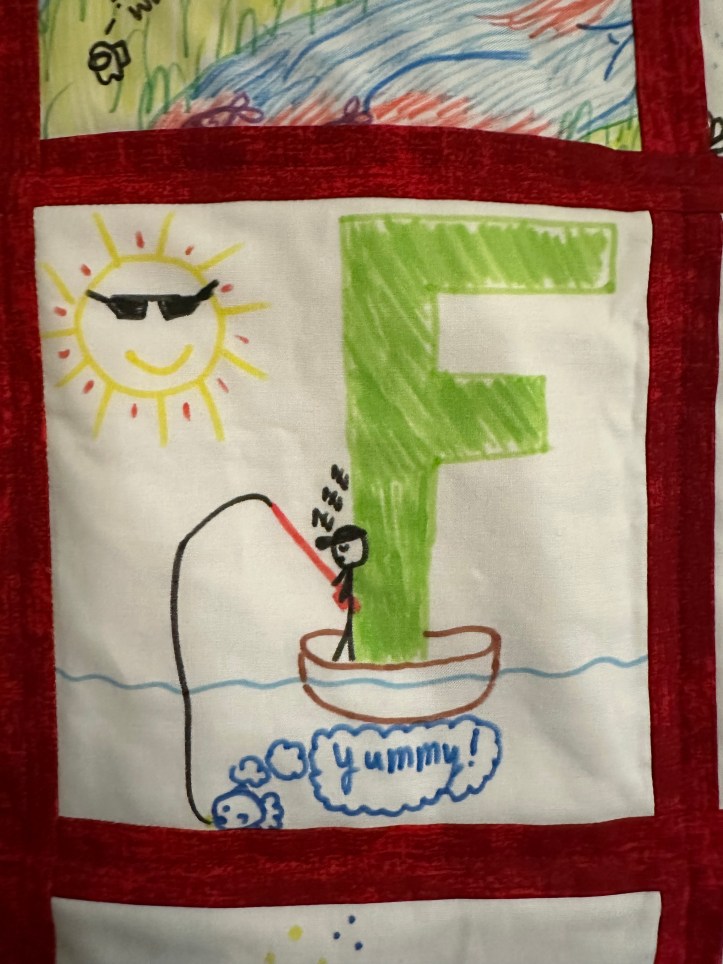
- Fishadelphia: Connecting Communities with Fresh Seafood — F square by Alexandra Rivera
- Residents of Savannah Rise to the Occasion as Higher Seas Encroach — G square by Lukas Garthwait
- How Urchins and the Blob Tag Teamed Kelp Forests (*heatwave) — H square by Karlie Russo
- Iceland’s Quest to Use 100 Percent of Its Fish Waste — I square by Nino Perilli
- Third row, left to right
- Something’s Jellyfishy in the State of Italy — J square by Evelin Gonzalez Flores
- Preparing for the Worst with a Kelp Seed Bank — K square by Christian Zavala Garcia
- Maine’s Lobster Fishing Community Confronts Their Changing Climate — L square by Matt Longo
- Protecting mangroves can prevent billions of dollars in global flooding damage every year — M square by Emmalin Molinaro
- Fourth row, left to right
- Restaurants in New Orleans are recycling oyster shells to save precious coastline — N square by Sara Knasiak
- Octopus farming in the U.S. would be banned under a new bill in Congress — O square by Madie Culbertson
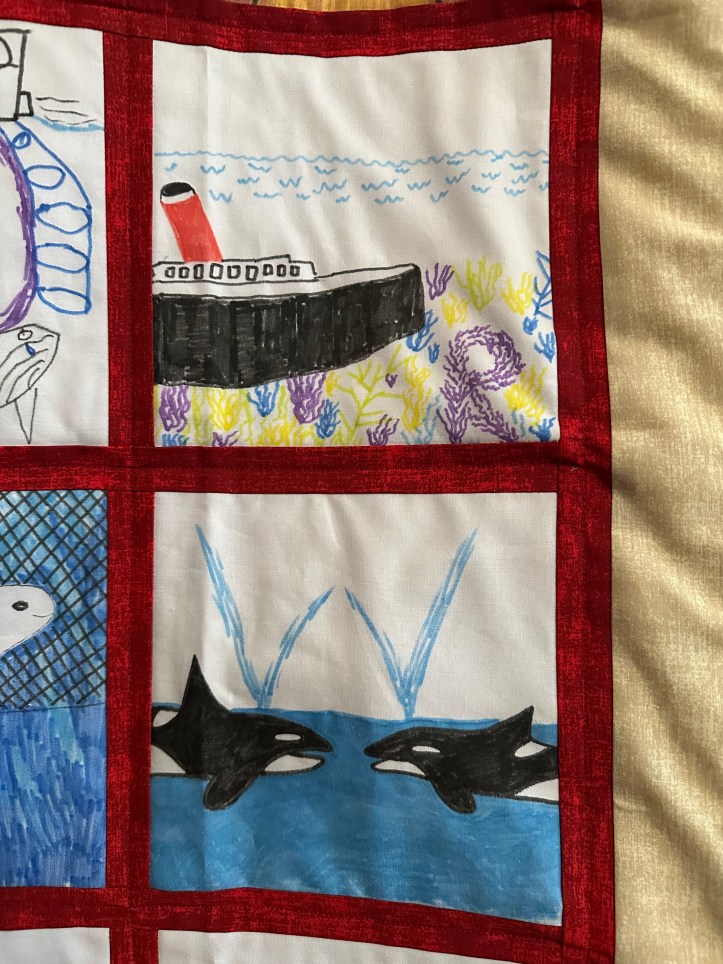
- Quiet Sound’s Voluntary Ship Slowdown Reduces Underwater Noise Reaching Killer Whales — Q square by Matthew Zhuang
- Artifical reef with the S.S. United States — R square by Justin Zachar
- Fifth row, left to right
- Northern Fur Seal Research in Alaska — S square by Mickayla Bless
- American Unagi Farms: Growing Eels, on Land, in Maine — U square by Natasha Agape
- The Poachers Who Could Save Mexico’s Vaquita — V square by Iyana Handy
- Why Can’t Killer Whales Find and Capture Food? The Ocean Is too Noisy — W square by Indiana Kelly
- Sixth row
- Blue blood from horseshoe crabs is needed for medicine, but a declining bird species relies on the crabs to eat (*horseshoe crab is member of the genus Xiphosura) — X square by Blessed Halm
This slideshow provides some close-ups of the student sketches.



These collaborative quilting projects are just incredible, from the reaction the students have to the continued discussion and sharing even after the semester concludes. These quilts will go on display in my campus library for National Quilting Month (March 2025), and then – who knows where the quilts will go???
Coastal Stories, brought to you by the letters… measures 36 inches across by 51 inches in height. It was started by the students with the quilt top finished in November 2024, and the final quilting stage was completed in February 2025.
 Journeys of Dr. G