
Follow along with me as I participate in the 2024 Save Your Story Challenge by Quilt Alliance. You can find all of my blog posts that are part of this challenge.

It’s fun for me to reflect back to where my journey into quilting started. I took my first quilting class in 2006 at a local JoAnn’s Fabric Shop, and fast-forward to 2024 when I’ve now created over 130 quilts. Since 2018, the majority of my quilts have focused on a science storytelling theme, ranging across topics such as the Louisiana Coast, climate solutions, and ocean expeditions (see my SciQuilt postings).
But I’ve received very little formal instruction on how to create quilts. Beyond the initial quilting class I took, I’ve read quilting magazines, viewed some online instructional videos, looked at images in Instagram and tried to recreate the patterns, and listened to quilt lectures virtually and through my quilting guild, Undercover Quilters (they are such a source of support and inspiration!). My day job as a college professor keeps me plenty busy, so I fit in quilting where and when I can.
I’ve also joined professional quilting organizations to learn more from the community. When a recent eNewsletter arrived from Quilt Alliance and I saw the Save Your Story Challenge, I knew it was something I wanted to participate in. Quilt Alliance has “a mission to document, preserve, and share our American quilt heritage by collecting the rich stories that historic and contemporary quilts, and their makers, tell about our nation’s diverse peoples and their communities.” And I believe that by participating in this Challenge, I will be able to have a more organized approach to documenting my own quilts and quilting journey.
Here’s a screenshot of the announcement in the Quilt Alliance newsletter (February 2, 2024):

And, here’s my response to January’s writing prompt!
I’m a co-coordinator of a global, annual stitching event called Stitch Your Science. Each year, we put out a call for not only quilters but anyone that knits, crochets, weaves, etc., to generate a science-themed piece that we share virtually and in-person. We keep in touch with each other via a Slack channel and offer updates on our progress and share other announcements. One of these announcements on July 14, 2022, was a call for submissions to be considered for The Changing Chesapeake exhibit at the Chesapeake Bay Maritime Museum in St. Michaels, Maryland.
The call was an open call centered on community response to changes in the Chesapeake Bay region. Any artistic medium was accepted (within a size and weight limit), and creators were asked to consider these questions for their piece:
–> How is climate change and/or the impact of humans on the environment shaping your Chesapeake community?
–> How has the way you identify with and are inspired by the Chesapeake evolved?
–> What would you want someone 100 years from now to know about your life and community traditions in the Chesapeake today?
–> What is your vision for the future of life in the Chesapeake region?
The submission of a photo and 150-word artist statement was due on September 1, 2022.
I’ve seen calls for juried exhibitions in the past and had never submitting something, but this call grabbed my attention. As a geologist and oceanographer that teaches about climate change and impacts in the coastal zone, I immediately had a scientific connection to this call. And for some time, I have been wanting to create a quilt relating to ghost forests to tell the story of how saltwater intrusion and rising sea levels impact coastal trees. I hadn’t created the quilt yet, but this call was my motivation to move forward!
As there was a size limit of 30 inches by 30 inches for any exhibit artwork, I decided to go with a single pane attic window (it’s one of my favorite quilt designs). I searched Spoonflower.com and found a fabric Winter Trees by terranacliff that would serve as a perfect ghost forest. For the fabric for the “wall” around the window, I decided to go with something that resembled a wooden wall that you might find on a beach house, purchased at JoAnns Fabric. I decided to use some fun blue crab fabric for the back and hanging sleeve as a nod to the Maryland blue crab, purchased (I believe) at The Crabby Quilter in Annapolis, MD.
I quickly stitched these fabrics together and then sat back and looked at the finished product. Immediately, a wave of sadness swept over me, as I was so unhappy with the result. To me, it didn’t look enough like a window. I was deflated from what I had produced, and I walked away from it for several days.
I eventually went back to the quilt and tried to figure out how I could make it look more like a window. I thought, what do all windows have? Curtains! But with the quilt top completed, I wasn’t sure how to add this feature. I knew curtains made of fabric would lie flat, and I wanted something that would have more of the natural folds of a curtain. I had never merged quilting with another medium before, and I’m not sure how I came up with the idea to crochet curtains to attach, but this is exactly what I did. The top of the curtains didn’t look very clean when I attached them to the quilt, so I also created a strip of fabric to cover the very top of the curtains, and we had a winner! This ended up being the 84th quilt I created, completed on August 8, 2022. The quilt measures 25 inches across by 29 inches tall (phew! Just under the size limit!) That same day, I submitted my entry for consideration.
If you are interested in the science story behind my ghost forests quilt, please see this blog post.

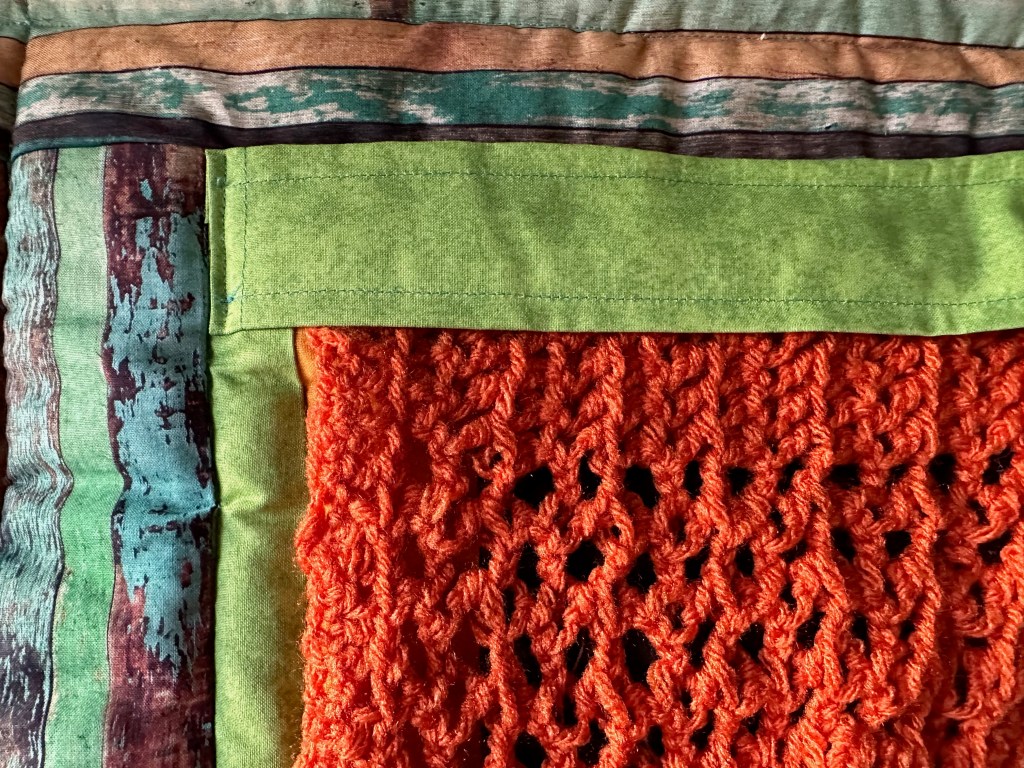

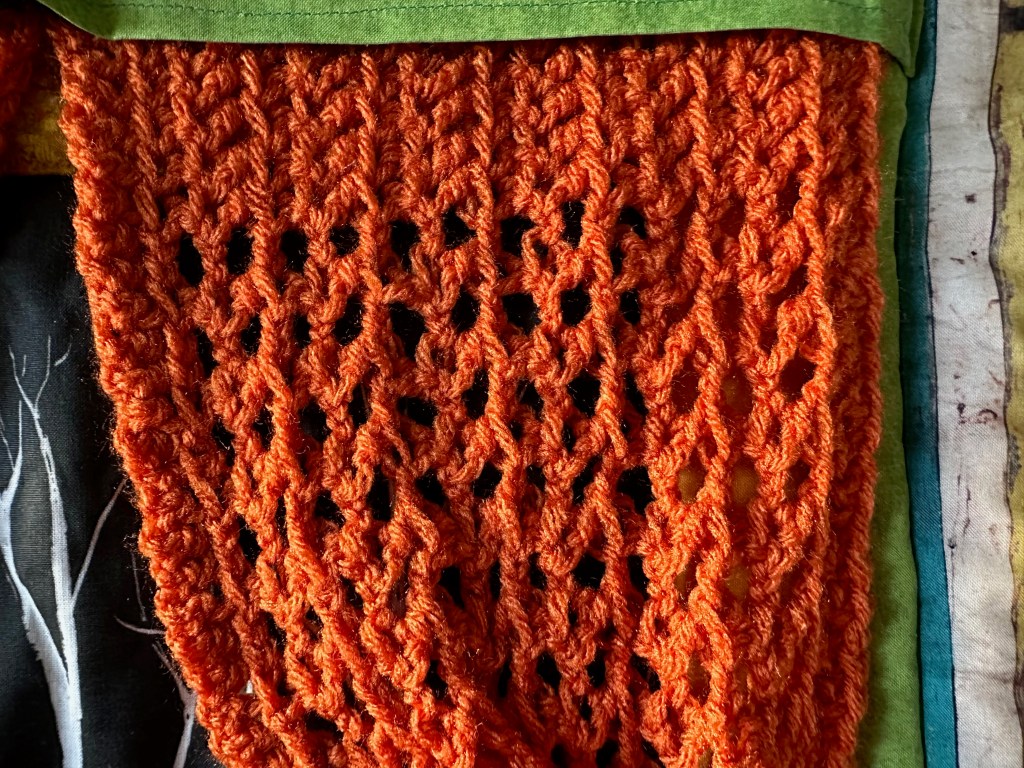
Now, it was time to wait and see what the jurors would decide. I didn’t hold out much hope that my quilt would be selected. Although I was significantly happier with the final product now that curtains were in place, I honestly didn’t think I would stand a chance getting chosen for a juried exhibit. My fall semester was about to begin, so my full focus went to preparing and teaching my courses, and I didn’t give much/if any thought to this completed quilt.
Then, on the last day of the fall semester, the following email message arrived in my Inbox:
Congratulations! Your submission has been selected by our panel for the community response exhibition “The Changing Chesapeake” at Chesapeake Bay Maritime Museum, which will open on February 23, 2023, and remain open through February 25, 2024. – (email from December 9, 2022)
I don’t think my eyes could have opened any wider or my jaw drop any lower when I read this email. It’s the first time I have ever had a quilt selected for a juried exhibition! And for this quilt that had given me so many problems when I was creating it… again, it was shock that I had a quilt selected, as well as it being “this” quilt! It still brings a smile to my face when I think of this moment.
Next up – getting the quilt to the museum! On December 22, my husband and I drove down to the Chesapeake Bay Maritime Museum to drop off the quilt. The museum is a two-hour drive from where we live (outside of Philadelphia). The weather was… not the worst to drive through, but very cold, very rainy, and it had snowed just days before. The museum was kind enough to contact us that day to see if we wanted to reschedule the delivery, but we were already on our way. Upon arrival we were met by the Curator and Folklife Center Manager who went over the details of the quilt, had me sign some paperwork, and then I had to say goodbye to the quilt. We had reserved a room at The Wildset Hotel to stay overnight before heading back to Philadelphia, and fortunately we had much clearer weather to drive back.
Although I knew I would be seeing my quilt in just a couple of months at the exhibit’s opening reception, it was hard to leave this one behind. I think because I struggled so much with the creation of this quilt, and I was so proud of my solution in combining the crocheting with quilting, having this finished piece for only four months prior to dropping it off was more emotional than I thought. But any sadness that I felt was overwhelmingly replaced by the pure joy that I would have a quilt part of a museum exhibit.
Fast-forward to the opening of The Changing Chesapeake exhibit, which was held on Thursday, March 2, 2023, from 5PM to 7PM. Neither my husband nor myself were teaching classes the next day (Friday) so we headed down after teaching our Thursday classes and stayed overnight again. I recall being so nervous about the event and my anxiety over meeting so many people that have a career as an artist, and I’m just an educator that does quilting. We arrived early and were shuttled over from the parking lot to the Steamboat Building. We walked up the steps and entered the front doors, greeted by volunteers and a check-in table. As I was giving our names to pick up our name tags, my husband tapped me on the shoulder and pointed to the left. Right in front of me on the wall, next to the opening sign for the exhibit, was my quilt!
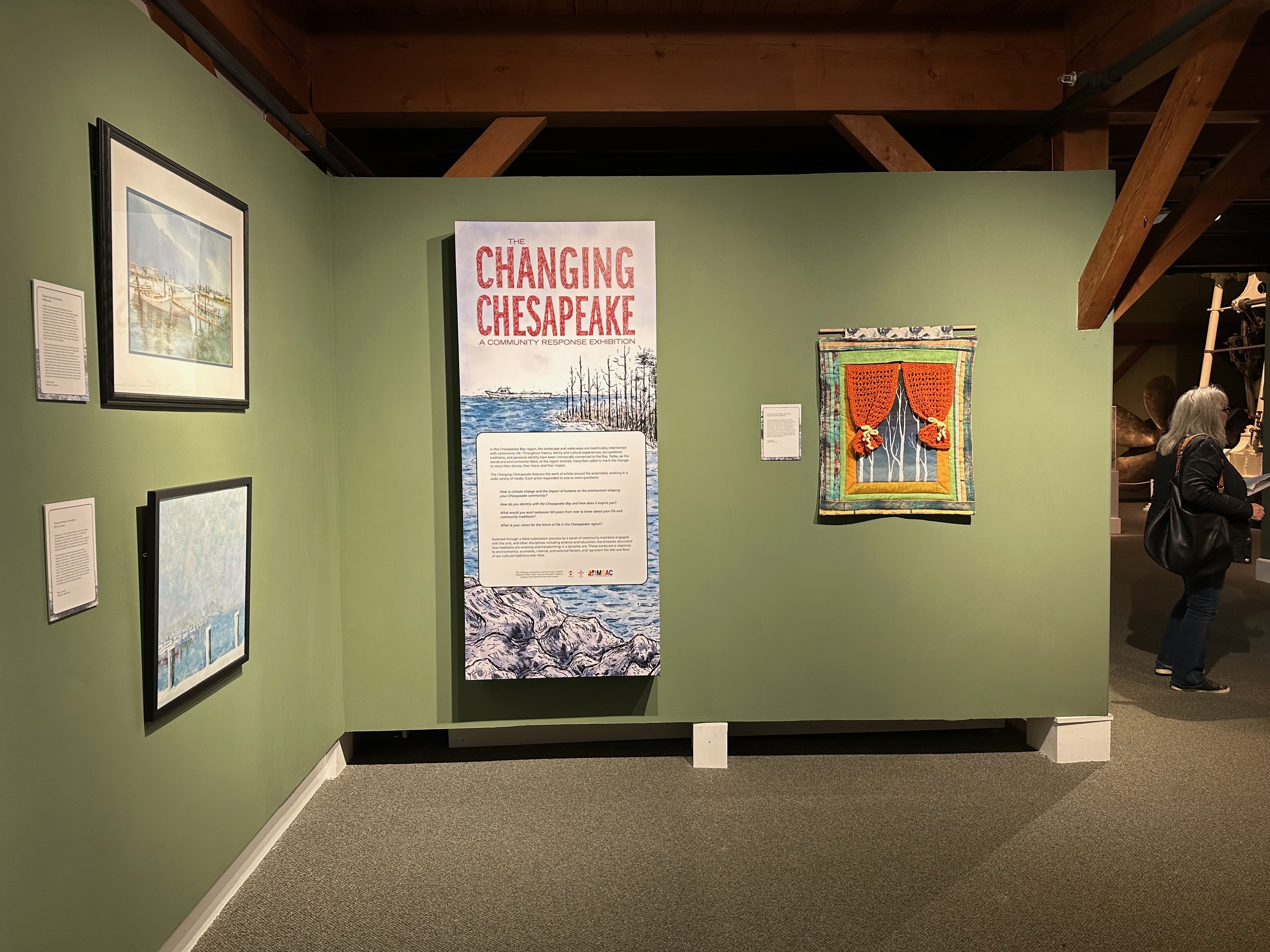
I immediately burst into tears, which I didn’t expect to happen. I just couldn’t believe that I had a quilt hanging in a museum, and at the entrance of the exhibit! The volunteers were so kind and even hugged me when I explained how much it meant to have my quilt as part of The Changing Chesapeake. I did a quick walk-through of both floors of the exhibit space, housing the 75 pieces selected for display. Then for the next two hours, I stood by my piece and shared stories of not only how I created the quilt but some of the science behind ghost forests. I was interviewed by a couple of news outlets, and I was quoted in at least seven articles appearing in outlets such as Chesapeake Bay Magazine and The Talbot Spy.

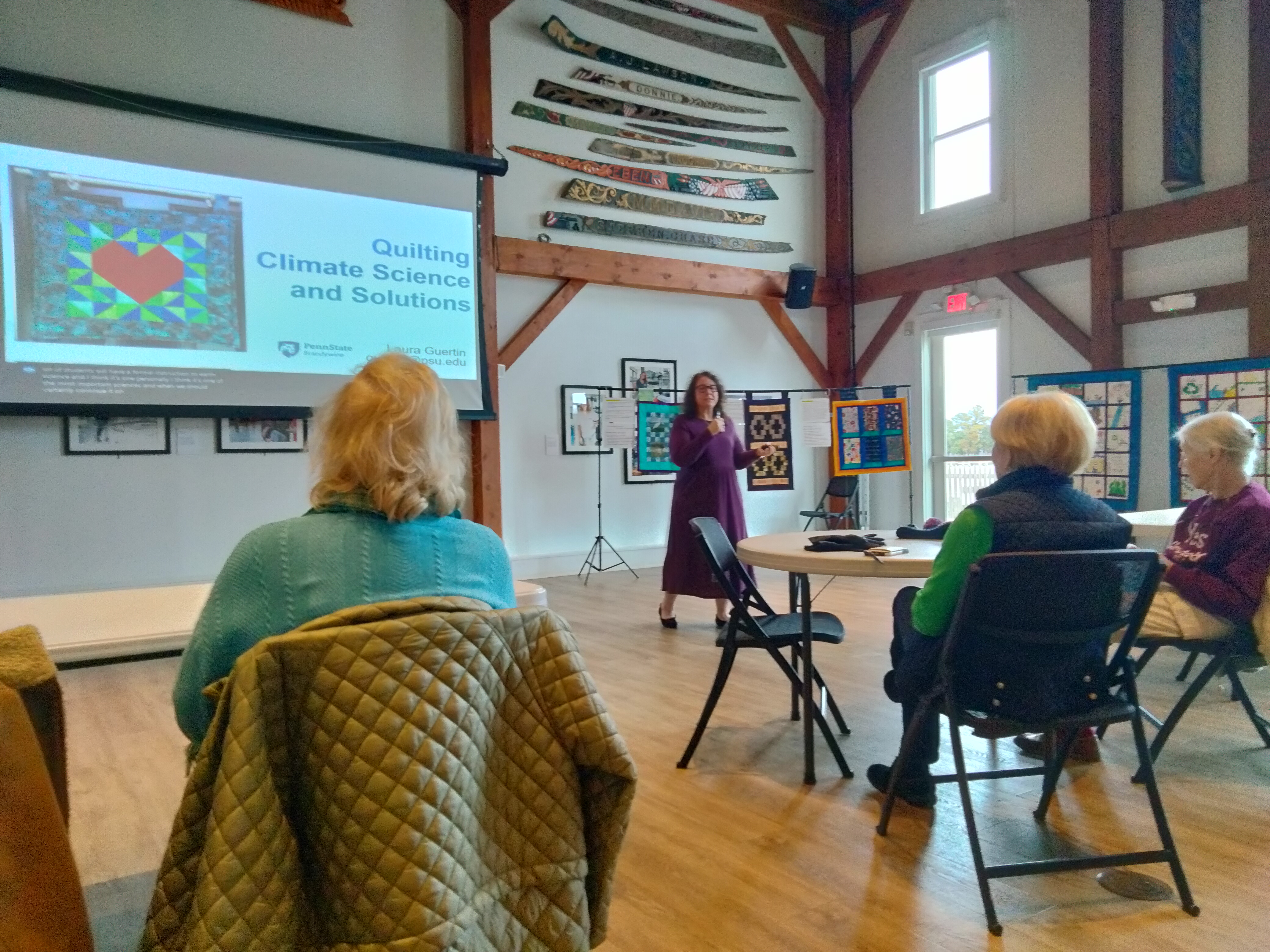
After the opening reception, I returned to the Chesapeake Bay Maritime Museum on January 4, 2024, to give a lecture on “Quilting Climate Science & Solutions.” I brought my Drawing Down Towards Climate Solutions quilts to display, along with the two quilts generated by my students in the Fall 2023 semester the explored coastal solutions to climate change. It was a great presentation in an incredible presentation space, the Van Lennep Auditorium on the CMBB campus. And we had such a rich Q&A session, I think I learned as much from the audience about their local coastal challenges as I shared with them!
I knew I would have one more trip to CMBB – this time, to retrieve my quilt upon the conclusion of The Changing Chesapeake exhibit. But to my surprise, this email appeared in my Inbox on January 24:
As we prepare to close “The Changing Chesapeake,” I want to thank you for your submission, which helped to make the exhibition at Chesapeake Bay Maritime Museum such a success. I will be sending an e-mail to coordinate pickup of artwork soon, but first we are reaching out to a few artists to inquire about acquiring their work for our collection. – (email from January 24, 2024)
This email triggered yet another set of tears over the quilt! I couldn’t believe that a museum would actually be interested in purchasing one of my quilts. This was a no-brainer decision for me. The Chesapeake Bay Maritime Museum was the first museum to ever accept one of my quilts to a juried exhibit. They displayed my quilt for a year, and gave me the opportunity to present to their museum members and the community about my broader science-themed quilts. There is no sadness here – just pure joy that my Looking Out at the Ghosts of the Coast quilt will be in the permanent collection of such a special museum.
This is such a journey and overall story about a quilt – but hopefully, as you can see, this is not just any quilt! Thank you, Quilting Alliance, for this challenge and encouraging me to take the time to document the story of my most meaningful quilt.
Below is a short video with a narration of myself describing the ghost forests of Chesapeake Bay along with images of the quilt, Looking Out at the Ghosts of the Coast. This quilt was part of The Changing Chesapeake exhibit at the Chesapeake Bay Maritime Museum (CBMM). The quilt was purchased by the museum after the year-long exhibition and is now part of their permanent collection (listing in catalog).
 Journeys of Dr. G